
THE GEORGETOWN STEAM PLANT
MAN & MACHINES
Construction of the Georgetown Steam Plant began in 1906 to power Seattle’s expanding electric streetcar system. Built from reinforced concrete as a direct response to the 1906 San Francisco earthquake, the plant was one of the first large-scale reinforced concrete structures of its kind on the West Coast. Representing a "fast-track" marvel of early industrial engineering, the primary structure was completed in only one year.
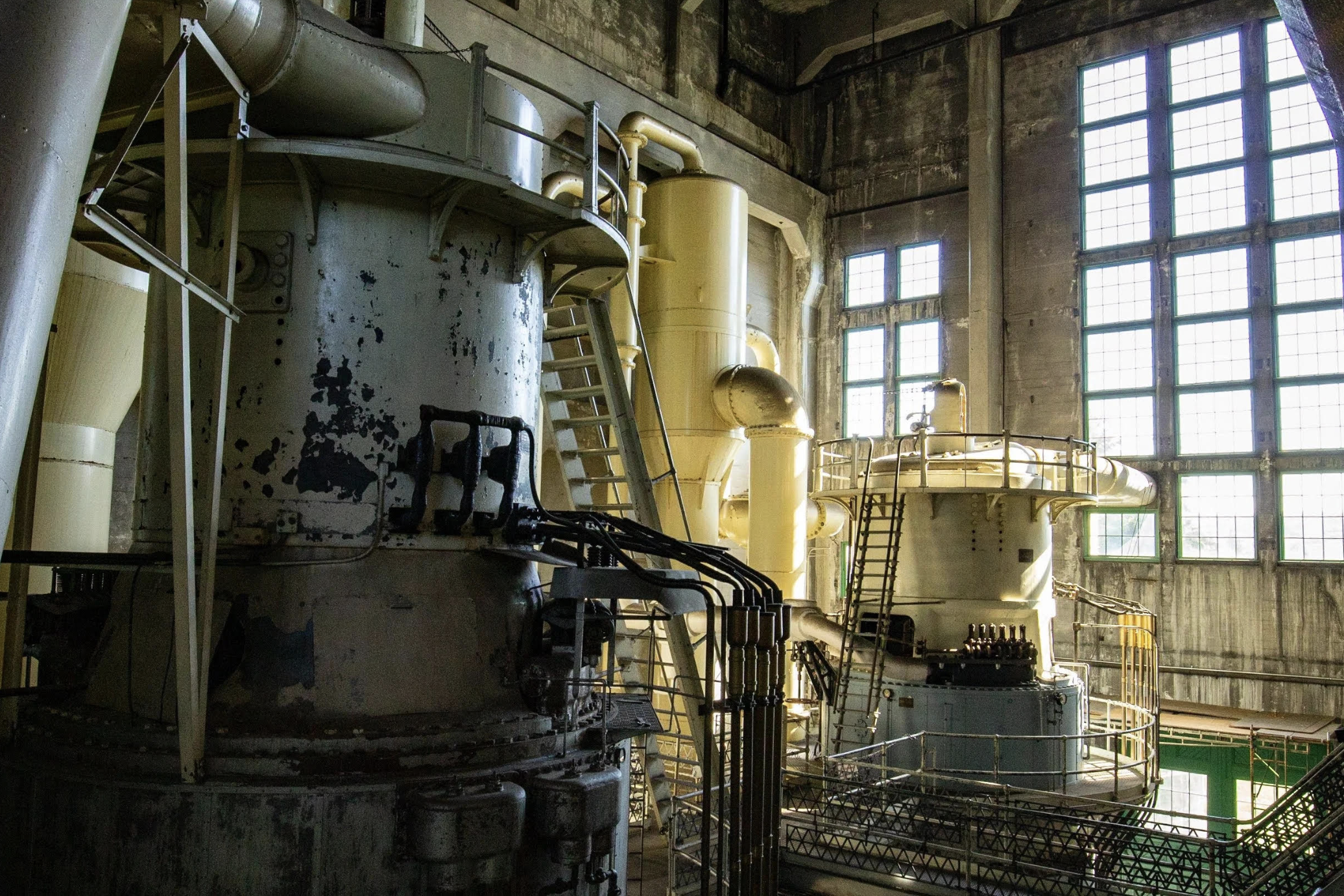
The plant’s power evolved through three distinct phases: Unit #1, a 3,000-kilowatt GE Vertical Curtis Turbine, became operational in 1907; followed in 1908 by Unit #2, an 8,000-kilowatt version of the GE Vertical Curtis Turbine. The third turbine, Unit #3, was installed in 1917. This 10,000-kilowatt GE Horizontal Curtis Turbine represented a major technological shift, showcasing the move toward the larger, more efficient horizontal designs that would become the industry standard. While the plant is world-renowned for housing the last two remaining GE Vertical Curtis Turbines, Unit #3 illustrates the site’s evolution and its vital role in Seattle’s industrial history.
The Georgetown Steam Plant now stands as a monumental relic of the fossil-fuel age. Constructed on the ancestral lands of the Duwamish dxʷdəwʔabš “The People of the Inside", it occupies the land of the 1851 Luther Collins Donation Land Claim—the first colonial claim in Seattle—making Georgetown the oldest neighborhood in Seattle.
Originally constructed on an oxbow of the meandering Duwamish River to access vital cooling water, the plant was forced to adapt when the river was straightened and channelized. Starting in 1913, this massive engineering project altered the landscape so significantly that by 1917, the plant was left landlocked. This geographic shift necessitated the construction of new infrastructure extending to a remote Pump House—located at present-day Gateway Park North—to maintain the plant’s essential connection to the river.
Despite its ambition, the Steam Plant’s operational life was relatively short-lived. As hydropower became the region’s dominant energy source, and the facility transitioned to a backup role before being officially decommissioned in 1977. Today, the Steam Plant stands as a powerful reminder of an era when colonial expansion and industrial machines began to reshape landscapes, rivers, and cities—setting the stage for the vast environmental injustices and climate challenges that now test the limits of human ingenuity.
Today, the Georgetown Steam Plant remains a site of global significance, as it is the home to the world’s last two General Electric Vertical Curtis Turbines still preserved in their original setting. Alongside a third horizontal unit, these massive machines represent the height of early 20th-century engineering and serve as a monumental testament to General Electric’s industrial legacy and its role in shaping the modern electrified world.
Stewarding the Future
In 2018, the Georgetown Steam Plant Community Development Authority (CDA) was established as Seattle City Light's non-profit partner. The CDA was formed for the sole purpose of realizing the Georgetown Steam Plant’s potential as a community center and one of Seattle’s most unique event spaces. Their dedicated work focuses on making this National Historic Landmark as safe and accessible as possible. Through community partnerships, the CDA aims to transform the Steam Plants role of housing the relics of General Electric’s legacy—which they affectionately refer to as The Industrial Cathedral—into a place for community to gather, learn, and dream.
To achieve this vision, the organization has assembled a dedicated team of architects, engineers, preservationists, and visioneers who are currently exploring the possibilities and planning the work within the constraints of the historic structure and modern building code. In 2025, the Georgetown Steam Plant was awarded the American Architecture Award in the Museums and Cultural Buildings category!
Stay tuned!!
The Atmospheric Context
In 1906, as the Georgetown Steam Plant rose in the Duwamish Valley, atmospheric CO2 levels were still below 300 ppm—a threshold that had not been exceeded for over 800,000 years. Throughout that vast history, CO2 fluctuated naturally between 170 ppm during glacial maximums and 300 ppm during the interglacial "comfort zone" in which human civilization flourished. For the first time in human story in 2026, driven by the fossil-fuel age, we have surpassed 430 ppm—a peak unseen in human history. The Steam Plant remains a monument to this shift, housing the massive machinery of the Second Industrial Revolution that helped power our global carbon transformation.
Preservationist~Debbie Pessein (2025)