
1851: The Tale of Two Revolutions
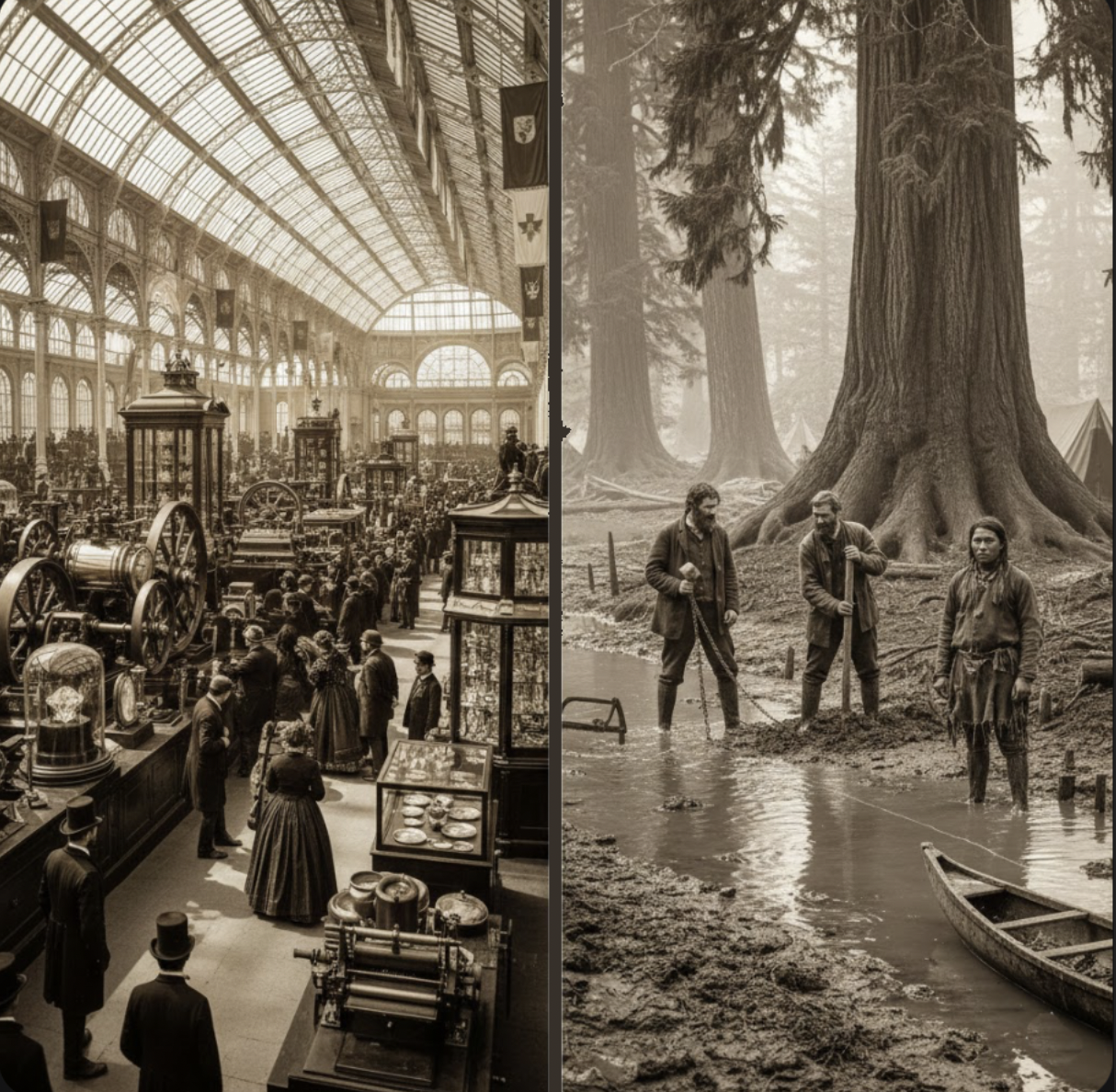
In 1851, the human story underwent a profound transformation. While the mechanical marvels of the first Industrial Revolution were on display at the Great Exhibition in Hyde Park, London, a more rugged version of that same revolution was being carved into the mud and landscapes of the Duwamish River. These events unfolded on opposite sides of the globe, yet they were part of the same story—a new industrial system was emerging that would reshape the natural world—an industrial system that set in motion the ecological crises we face today, compelling us toward the next great Industrial Revolution.
The Cathedral of Glass
On May 1, 1851, the Great Exhibition—the world’s first official World Fair—opened in Hyde Park, London. At its center stood the Crystal Palace, a structure that was itself a technological and ideological breakthrough. Built in just 190 days using standardized nuts and bolts, its vast iron frame and 300,000 panes of glass enclosed the “Works of Industry of All Nations.”
Inside the Crystal Palace, a new Industrial Mindset was taking shape—steam engines, mechanized looms, high-speed printing presses, the first telegraph cables, and contraptions galore stood as symbols of human ingenuity. Coal and steam were framed as inexhaustible forces of progress; the Earth, as a warehouse of raw materials awaiting conversion, and progress was presented as upward momentum—measurable, mechanical, and inevitable.
To the Victorian eye, the Crystal Palace was proof that humanity had finally triumphed over nature, they embraced the machines with wonder and awe. The Great Exhibition was the coronation of the idea that the natural world could be mastered, reordered, and endlessly optimized.
Land Claims on the Duwamish River
Thousands of miles away, a different kind of revolution was unfolding along the banks of the Duwamish River when Luther Collins, the Maple family, and Henry Van Asselt became the first European Americans to explore and stake claim to the lands that had sustained the Coast Salish Duwamish People since time immemorial. On September 16, 1851, they drove stakes into the earth and under the Donation Land Claim Act transferred these living landscapes into private property. Next in line was the Denny Party who staked their claims for Alki Point on November 13th, 1851.
While London celebrated the machines of the industrial age, settlers in the Duwamish Valley and surrounding landscapes began to deploy tools of erasure. The crosscut saw and broadaxe felled ancient forests to make way for homesteading and city building. The plow tore through complex root systems of native plants cultivated and harvested for generations, replacing them with Western agriculture. The surveyor’s transit imposed straight, mathematical lines over a winding river and communal forests. Behind it all stood the rifled musket—the ultimate technology of colonial enforcement, finalizing the transfer of land and sovereignty into the hands of the newcomers.
There was no just transition—displacement for the first people was swift and devastating. Governed by manifest destiny, reinforced by politics, religion, and codified through private property, the promise of economic prosperity took hold. From these forces emerged Georgetown, Seattle—now recognized as Seattle’s oldest neighborhood.
The Legacy of 1851
With ruthless efficiency, the upward momentum of industry merged with the claims of private property, evolving into a global system of colonialism and resource extraction. Industry required land; land required dispossession. What was framed as humanity’s triumph over nature soon became a feedback loop of resource depletion, pollution, and inequality. The ecological crisis of today was set in motion at this convergence—when industrial ambition met colonized land, and when progress was defined without limits, consent, or accountability. Rivers were engineered into working waterways and conduits for trade, wetlands into industrial wastelands, and communities into labor forces.
Why a Science Fair?
The Georgetown Science Fair exists because the story that began in 1851 is not finished. It was born from a moment when industry was celebrated without consequence and land was claimed without consent. Georgetown sits at the intersection of those histories. This is not an abstract backdrop. The power plants, rail lines, factories, and waterways that shaped the Industrial Age still define the neighborhood’s landscape and its environmental burden. Georgetown is a place where the legacy of machines is felt in the air, the soil, and the river—and where communities continue to live with the consequences of decisions made over 170 years in the past—seven generations.
The Georgetown Science Fair is a deliberate inversion of the 1851 World’s Fair model. Where the Crystal Palace celebrated domination over nature, this fair asks what it means to live in relationship with it. It is not a showcase of finished answers, but a public celebration—one that invites artists, scientists, engineers, students, elders, and neighbors to experiment together, share their work, and have fun together.
Here, innovation and ingenuity are measured not by speed or scale, but by their ability to heal land, water, and communities. The Science Fair centers local knowledge alongside emerging technology, Indigenous wisdom alongside speculative futures, and lived experience alongside data. In the shadow of the machines that once defined progress, the Science Fair asks a new question: What would industry look like if it were designed to repair the world it depends on?
SPECIAL EXHIBITION: 1851
The story that began at the 1851 World’s Fair and tamed the landscapes of Seattle’s first people, the Duwamish, is not over; it is etched into the very soil, air, and water of Georgetown and surrounding communities. While the original Great Exhibition celebrated the mechanical world, we invite you to put the gears of history under the microscope—from the monumental shifts in our climate to the weird and wacky world of invention and human ingenuity.
If the blueprints of 1851 shaped our present, we are calling on artists, scientists, and neighbors to help us plant the seeds for 2200. Drawing from Indigenous knowledge, speculative technology, or lived experience in the Duwamish Valley, this is your invitation to embrace complexity, celebrate the wonders of invention, and lean into the next Industrial Revolution—one where the greatest technical advancements will be measured by their capacity to repair and sustain living systems.