
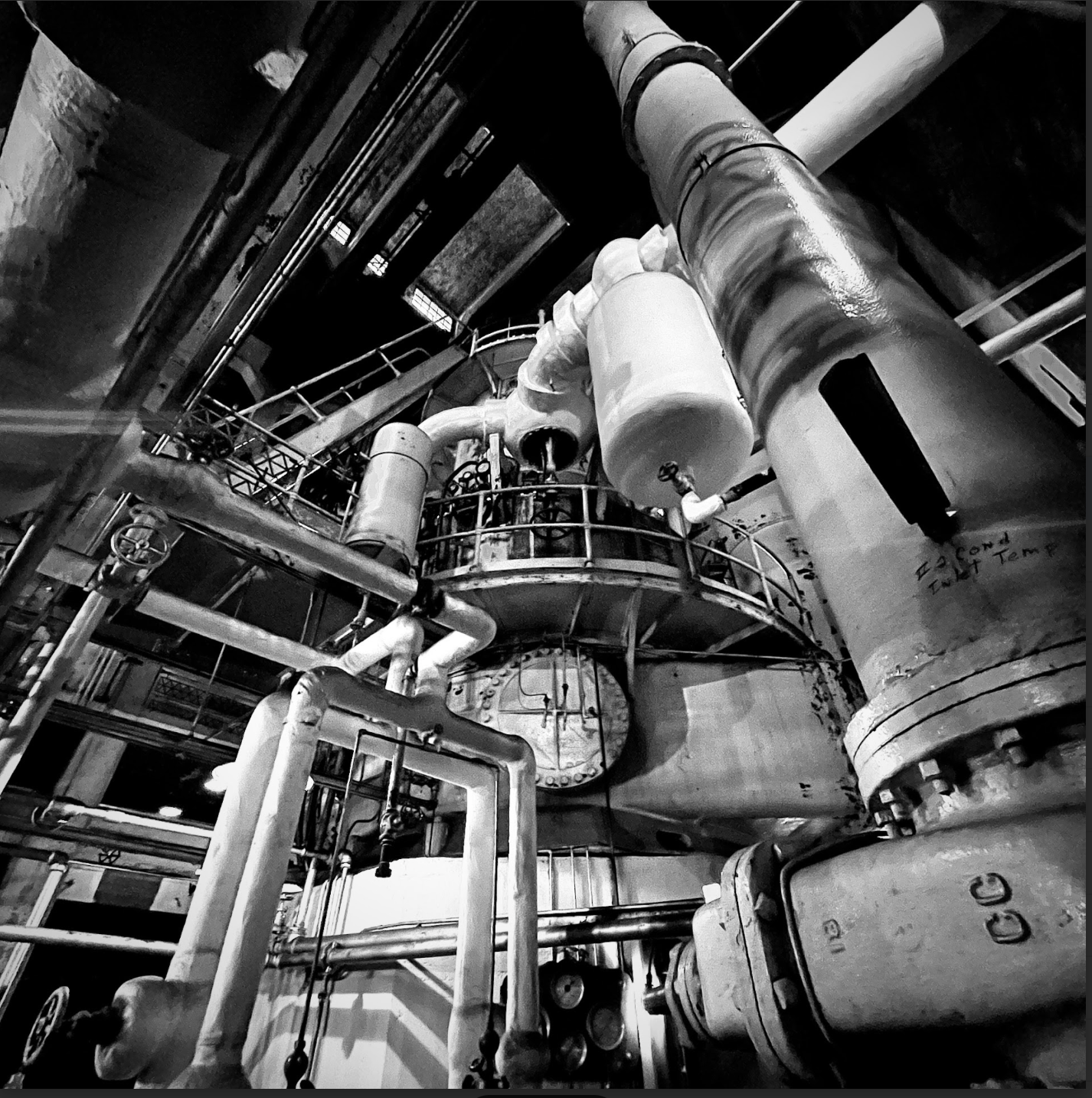

Building on the momentum of the 2025 Science Fair theme, “Break the System,” the 2027 theme, “Man & Machines,”examines a world increasingly defined by complex, interdependent systems—and the machines we have built to operate within them.
The first two Industrial Revolutions marked humanity’s great mechanical leap forward. We moved from hand tools to horsepower, from steam to combustion, transforming how we produced energy, moved people and goods, and built cities. But this extraordinary expansion of human capability came with consequences: resource depletion, industrial pollution, climate change, and growing pressure on biodiversity and ecosystems.
The Georgetown Steam Plant stands as a powerful monument to this transformation. Its massive steam-driven machines converted fossil fuels into electricity that powered streetcars, factories, and homes, helping fuel the growth of modern Georgetown. But these machines were part of a larger energy system. As hydropower and long-distance transmission expanded, the Steam Plant became increasingly expensive to operate and was eventually decommissioned in 1977.
Today, many of our most powerful machines are no longer visible as machines. They exist behind screens and software—in data centers, neural networks, artificial intelligence, and global communications infrastructure. Yet they remain intensely physical, consuming enormous amounts of electricity, water, land, and materials.
The machine has changed. The appetite has not.
As computational systems become increasingly embedded in everyday life, they are reshaping not only how we work and communicate, but how energy is produced, distributed, and consumed.
This trajectory is redefining how—and where—energy is produced and consumed. To sustain this growing energy demand, our computational systems are moving us toward a Type I civilization on the Kardashev Scale—one capable of harnessing full mastery of our planetary energy flows. Beyond that lies the speculative horizon of a Type II civilization, capturing the full radiant output of the sun.
We built machines to extend our reach, amplify our abilities, solve problems, and manage systems beyond the capacity of any one person. Now, as those systems grow more complex, we are increasingly turning to our creations to help us navigate the world we have built.
But what kind of relationship are we creating?
The 2027 Georgetown Steam Plant Science Fair follows this trajectory—from the mechanical spectacle of the industrial age, through the computational revolution of the digital age, toward an uncertain future in which humans and machines are becoming increasingly integrated.
This is the Age of Integration.
Will our machines remain our tools—or become our partners, our extensions, our servants, or our replacements?
Man & Machines invites artists, scientists, designers, engineers, technologists, and thinkers to explore this evolving relationship between human agency and the systems we create. We seek work that examines the technologies, infrastructures, energy systems, and hybrid ecologies shaping our world—past, present, and emerging.
We are especially interested in projects that blur the boundary between science fiction and the present, revealing futures that are already taking shape. How does technology extend human capability? How does it redistribute power, reshape landscapes, consume resources, and alter the systems on which we depend?
What kind of future are we building—and who, or what, will build it with us?